


Electromagnetic Compatibility in the Electric Vehicle Era
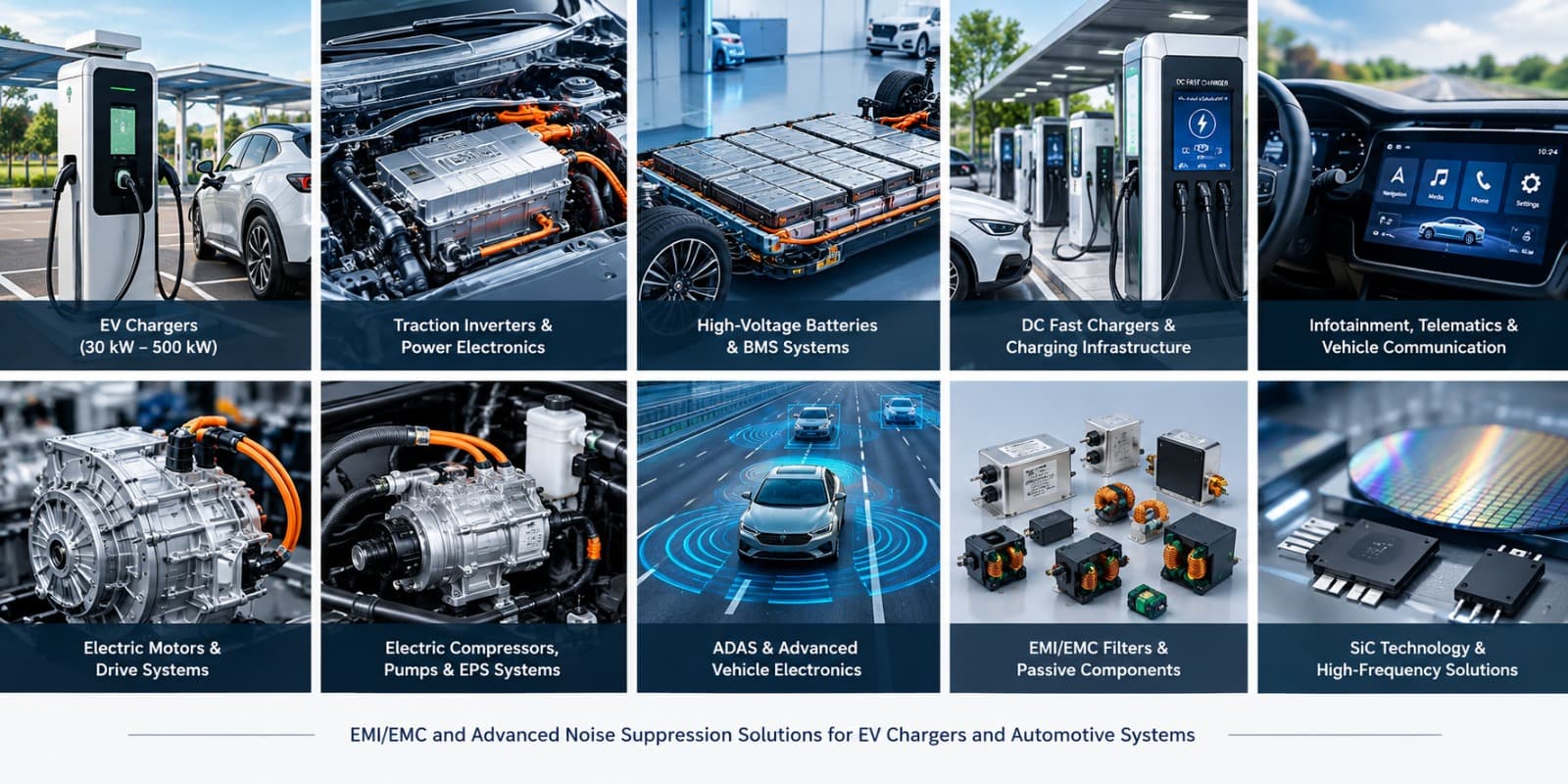
The automotive industry is undergoing a fundamental transition from conventional internal-combustion powertrains to highly electrified architectures based on high-voltage batteries, onboard chargers (OBC), DC fast chargers, traction inverters, DC-DC converters, battery-management systems (BMS), electric compressors, electric pumps, EPS systems, ADAS electronics, infotainment, telematics and high-speed vehicle communication networks. This transformation has dramatically increased the amount of power electronics operating inside the vehicle and charging infrastructure. At the same time, modern EVs are moving toward 400 V and 800 V platforms, silicon-carbide (SiC) switching devices, higher switching frequencies and higher charging powers. These technologies improve efficiency and reduce charging time, but they also create significantly more challenging EMI, EMC, common-mode noise, differential-mode noise, conducted emissions, radiated emissions and transient-noise problems.
BLA ETech operates directly in this environment, with a published product range covering EV chargers, EMI/EMC filters, DC filters, single-phase filters, three-phase filters, common-mode chokes, inductors, reactors, DC chokes, PFC chokes, sine-wave filters, harmonic filters and customized filters. BLA also states that its EV chargers range from 30 kW to 500 kW, while its broader EMI/EMC capability includes OEM/ODM and custom filter engineering.
Why EVs Create a New EMI Challenge
An electric vehicle contains several high-power switching systems operating simultaneously. The battery supplies DC energy to the traction inverter, which converts the DC bus into controlled three-phase power for the electric motor. The OBC converts AC grid power into DC battery power, while auxiliary DC-DC converters generate low-voltage supplies for vehicle electronics. Electric compressors, pumps, fans, steering systems and other actuators also contain switching electronics.
The fundamental problem is the extremely fast switching of modern power semiconductors. SiC MOSFETs, for example, can switch with very high dv/dt and di/dt, reducing switching losses but increasing the high-frequency spectral content of the voltage and current waveform. These high-frequency components can couple through parasitic capacitances between the inverter, motor, chassis and battery system. They can then propagate through HV cables, LV harnesses, shield structures and vehicle grounding networks. BLA's EMI engineering capability is aimed at controlling these unwanted currents through appropriately designed common-mode, differential-mode and broadband filtering architectures.

EMI in Onboard Chargers
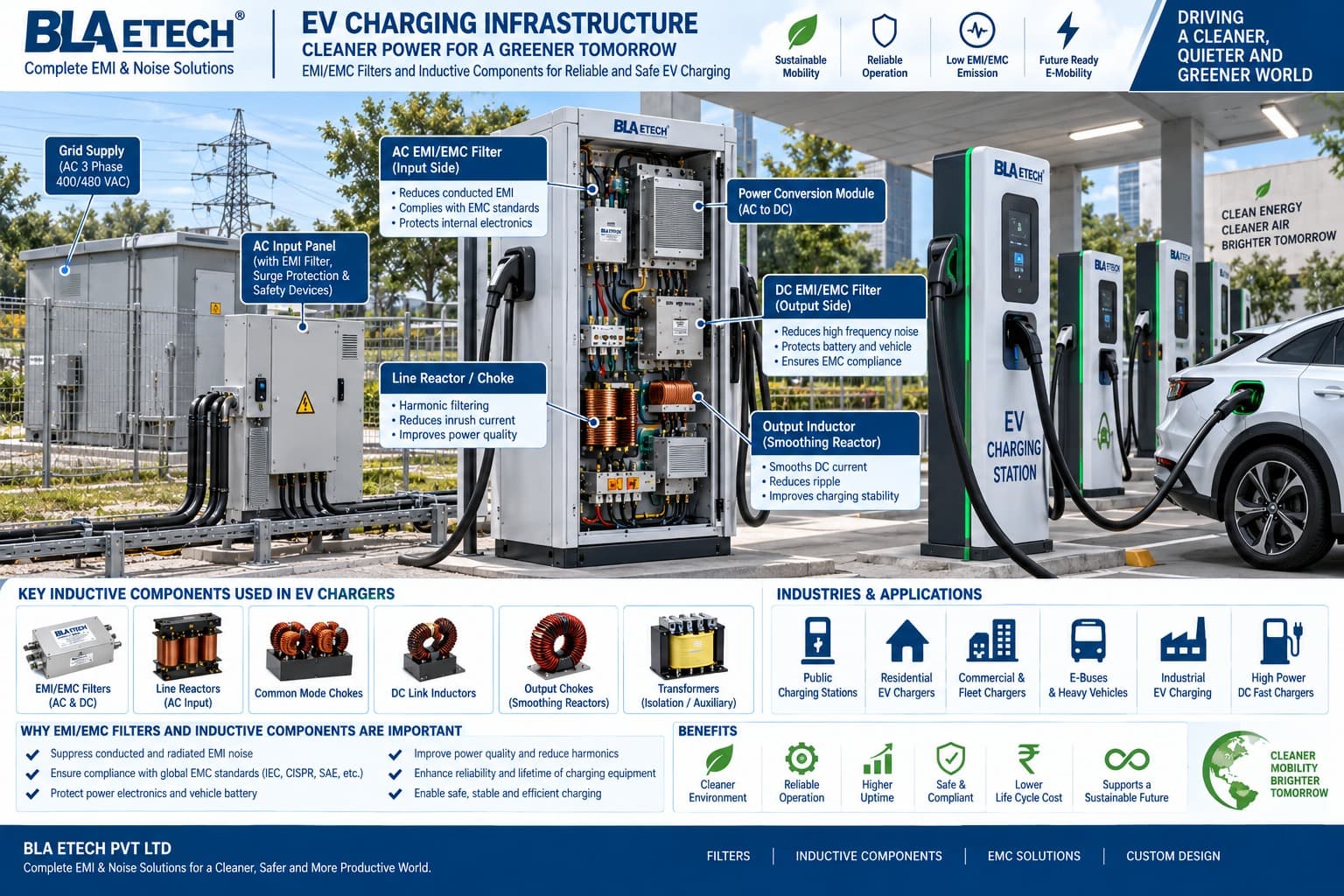
The onboard charger (OBC) is one of the most important EMI sources in an EV because it combines AC mains input, PFC circuitry, high-frequency switching, galvanic isolation and high-power DC charging. A modern OBC may contain an AC input stage, active PFC, isolated DC-DC converter and high-voltage battery interface.
The PFC stage can generate both differential-mode and common-mode conducted emissions, while the isolated DC-DC stage can introduce additional high-frequency common-mode currents through transformer parasitic capacitance. BLA can address these paths using single-phase EMI filters, three-phase EMI filters, common-mode chokes, differential-mode inductors, X/Y capacitors, DC EMI filters, ferrite components and multi-stage LC filtering.
For automotive OEMs, the filter can be developed around the actual OBC topology, switching frequency, power level, voltage and mechanical envelope rather than simply selecting a generic mains filter.
Single-Phase EMI Filters for AC EV Charging
Residential and lower-power AC EV chargers typically operate from single-phase supplies. BLA can provide single-phase EMI/RFI filters for AC EVSE and charging equipment. The filter can incorporate common-mode and differential-mode attenuation using combinations of common-mode chokes, differential inductors, X capacitors and Y capacitors.
The design challenge is to obtain high attenuation across the relevant conducted-emission frequency range while maintaining acceptable leakage current, thermal performance and power loss. This becomes increasingly important as chargers move toward higher switching frequencies and more compact power-electronic architectures.
Three-Phase EMI Filters for Commercial and High-Power EV Chargers
Commercial AC chargers and high-power DC charging stations generally use three-phase input power. BLA offers three-phase EMI filters and three-phase-plus-neutral filters within its product range, making this architecture directly relevant to high-power EV charging equipment.
In a high-power charger, the input filter must handle substantial continuous current while suppressing switching noise generated by the rectifier and PFC stages. BLA can engineer the filter around input voltage, current, switching frequency, source impedance, required insertion loss, thermal rise, leakage current and enclosure dimensions.
DC Fast Charging and High-Power Switching Noise
The transition toward high-power DC charging creates an even more demanding EMI environment. BLA currently advertises EV charger products including 30 kW, 60 kW, 120 kW, 180 kW, 240 kW, 360 kW and 500 kW classes on its website.
At these power levels, the DC bus carries very high current, and high-frequency switching currents can create significant common-mode and differential-mode noise. The filter must therefore be designed not only for EMI attenuation but also for low conduction loss, magnetic saturation margin, thermal management, creepage and clearance, mechanical strength and long-term reliability.
BLA's combination of EV-charger manufacturing and EMI/EMC component manufacturing provides an important advantage because the charger and its filter architecture can be considered together rather than treating the EMI filter as an external afterthought. BLA states that its EV chargers incorporate EMC/EMI filters and that its chargers are positioned as ARAI-approved and TUV-certified products.
400 V and 800 V EV Architectures
The automotive industry is increasingly moving toward 800 V-class electrical architectures to enable higher charging power with lower current for a given power level. However, higher voltage and faster switching create new insulation, parasitic-capacitance and common-mode-current challenges.
For example, at the same charging power, moving from a 400 V system toward 800 V reduces the required current, but the switching voltage transitions and electric-field stress can become more demanding. High-frequency common-mode currents can couple through stray capacitances and cable shields.
BLA can develop high-voltage DC EMI filters, common-mode chokes, DC chokes, differential-mode inductors and custom filter assemblies for these higher-voltage architectures.


SiC and Wide-Bandgap Semiconductor Noise
The adoption of SiC MOSFETs and other wide-bandgap semiconductor technologies is one of the most important changes in EV power electronics. Higher switching frequencies and faster switching transitions allow smaller magnetics and improved efficiency, but they also increase the high-frequency content that must be controlled.
The challenge is particularly important in traction inverters, OBCs and DC fast chargers, where high dv/dt can produce common-mode currents through parasitic capacitance. BLA can counter these effects through carefully designed common-mode chokes, DC-link chokes, output reactors, differential-mode inductors and high-frequency ferrite suppression.
The magnetic component itself must be optimized for high-frequency operation because core losses, winding proximity effects, skin effect and parasitic capacitance become increasingly important.
Common-Mode Chokes for EV Systems
Common-mode chokes (CMC) are fundamental to EV EMI suppression. They provide high impedance to common-mode currents while allowing the desired differential power current to pass.
BLA manufactures common-mode chokes and custom magnetic components and can design them around the actual current, voltage and frequency characteristics of an EV application. For high-current applications, the design must account for core saturation, DC bias, copper loss, core loss, leakage inductance, winding capacitance and thermal rise.
In an OBC, CMCs may be used on the AC input. In a DC fast charger, they may be required on DC or AC interfaces. In automotive applications, common-mode chokes can also be applied to high-voltage power paths and auxiliary electronics.
Differential-Mode Inductors and DC Chokes
Differential-mode noise exists between conductors and is generated by switching current ripple. BLA can address this using differential-mode inductors, DC chokes, series inductors and LC filters.
DC chokes are particularly relevant to the input and output stages of high-power converters. BLA's published product portfolio specifically includes DC chokes and PFC chokes, allowing the filtering and power-quality architecture to be designed around the converter rather than relying solely on capacitive filtering.
PFC Chokes for EV Chargers
Power-factor correction is a fundamental part of many AC-to-DC EV charging systems. The PFC stage controls input current so that the charger presents a more desirable load to the AC supply. However, high-frequency PFC switching also generates ripple and EMI.
BLA offers PFC chokes as part of its power-quality product range. These magnetic components can be engineered according to the PFC topology, switching frequency, current waveform, inductance requirement, saturation margin and thermal conditions.
The PFC choke therefore becomes both a power-conversion component and an important element of the overall noise-control architecture.
AC Line Reactors and Input Reactors
High-power EV chargers can benefit from AC line reactors and input reactors that introduce controlled impedance into the AC power path. BLA's product portfolio includes reactors and inductive components for input and output applications.
A reactor can help control current ripple, reduce certain transient components and provide additional impedance to high-frequency disturbances. When combined with a properly designed EMI filter, it can form part of a comprehensive input power-conditioning system.
DC Link Chokes and DC Bus Noise
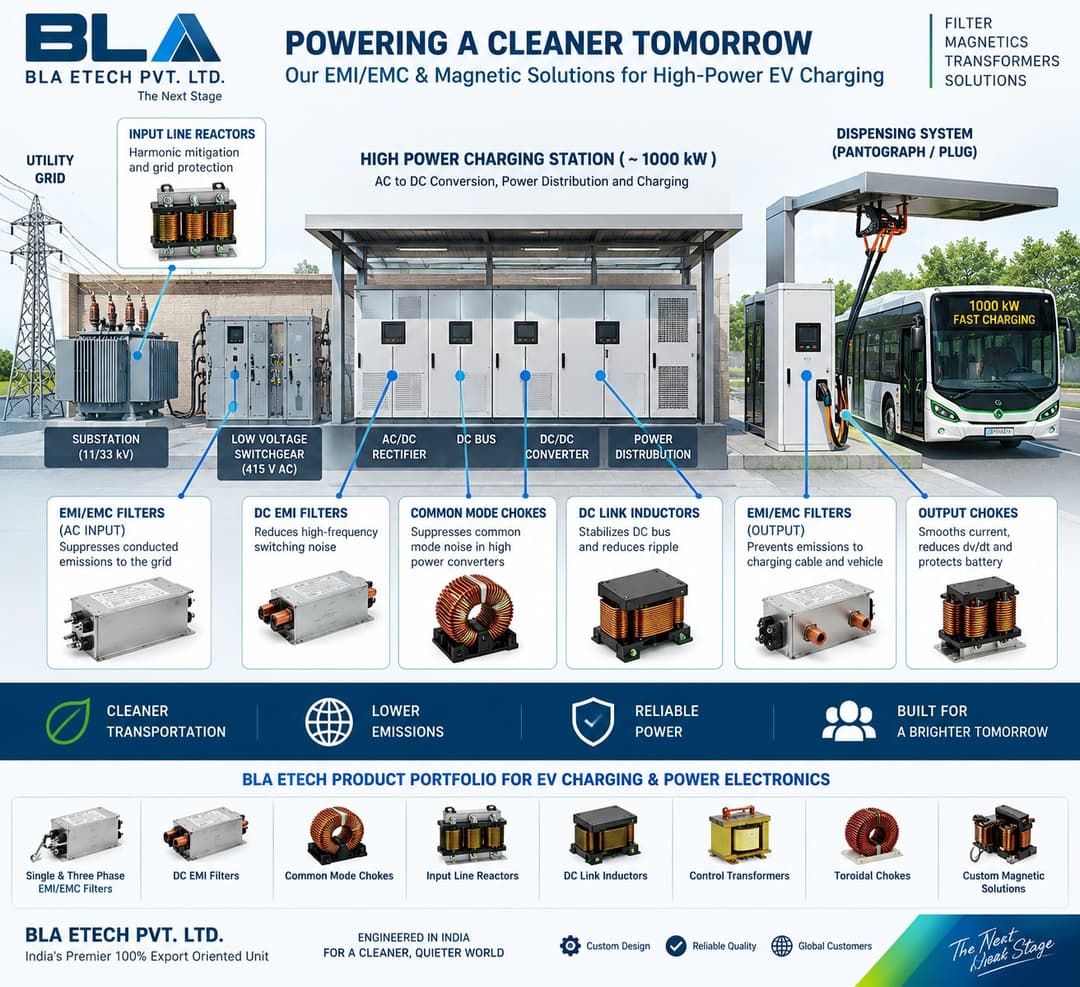
The DC link connects different stages of a power converter and can become an important path for high-frequency noise. In an EV traction inverter, for example, the battery connects to the DC link, which feeds the three-phase inverter.
BLA can engineer DC link chokes, DC reactors and DC EMI filters to increase impedance to unwanted current components. The design must consider both the DC operating point and the AC ripple current superimposed on the DC current.
At high power, magnetic saturation is a critical consideration. A choke that performs correctly at small-signal conditions may behave very differently under the high DC bias present in an EV traction or charging system.
Traction Inverter and Motor EMI
The traction inverter is arguably the most demanding EMI source inside an EV. It converts the battery's DC voltage into a PWM waveform for the traction motor. The rapid voltage transitions can generate common-mode currents through motor winding-to-frame capacitance, motor cable capacitance and inverter heatsink/chassis capacitance.
These currents can travel through the vehicle structure and potentially interfere with other electronic systems. BLA can provide three-phase output reactors, motor chokes, common-mode chokes, dv/dt filtering and custom LC/output filtering solutions.
The objective is to reduce unwanted high-frequency voltage components while preserving the required motor control bandwidth and efficiency.

Electric Motor Bearing Currents and Common-Mode Voltage
High-frequency common-mode voltage generated by the inverter can also contribute to shaft voltages and bearing currents. The exact mechanism depends on motor construction, inverter topology, switching behaviour, parasitic capacitance and grounding architecture.
BLA's common-mode chokes, output reactors and high-frequency filtering solutions can form part of a system-level strategy for reducing these unwanted currents. Filter design should be coordinated with motor construction, cable shielding, grounding and inverter switching strategy rather than treated as an isolated component decision.
Automotive DC-DC Converter EMI
An EV contains several DC-DC converters that transform the high-voltage battery bus into lower-voltage rails for conventional automotive electronics. These converters supply systems such as lighting, infotainment, controllers, sensors, ADAS electronics and 12 V/48 V auxiliary networks.
The high-frequency switching currents can propagate through the vehicle's electrical architecture. BLA can develop DC EMI filters, common-mode chokes, differential-mode inductors, ferrite beads, ferrite cores and multi-stage LC filters for these converter interfaces.
Filtering must preserve the converter's dynamic response while reducing conducted noise over the relevant frequency range.
Automotive EMI and CISPR 25
Automotive electronics must control both emissions from the vehicle and susceptibility of vehicle electronics to external electromagnetic disturbances. CISPR 25 is a key automotive EMC reference addressing radio-disturbance characteristics for the protection of receivers used on board vehicles.
This makes EMI filtering important not only for the traction inverter and OBC but also for smaller electronic subsystems. A DC-DC converter that creates a narrowband or broadband disturbance can potentially interfere with AM/FM, GNSS, cellular, Bluetooth, Wi-Fi or other vehicle radio systems if the noise reaches the relevant frequency bands.
BLA can design filtering around the actual measured noise spectrum rather than simply applying a generic low-pass filter.
ISO 11452 and Automotive Immunity
Automotive EMC is also concerned with immunity. ISO 11452 addresses electrical disturbances by narrowband radiated electromagnetic energy and provides component-level immunity test methods.
This means that automotive electronics must not only avoid generating excessive electromagnetic noise but must also continue operating correctly when exposed to electromagnetic fields. BLA's EMI filter and shielding solutions can contribute to controlling conducted coupling paths, although complete vehicle EMC performance also depends on enclosure design, cable routing, grounding, shielding and system architecture.
EV Charging EMC and IEC 61851
The charging interface itself has become increasingly sophisticated. IEC 61851 defines requirements for conductive EV charging systems, while IEC 61851-21-1 addresses EMC requirements associated with the connection of an EV to AC or DC supplies. A 2026 edition of IEC 61851-21-1 is now published, covering EMC requirements for onboard charging systems tested at vehicle/component level.
India has also updated its EVSE framework. BIS published IS 17017 (Part 23):2026, a modified adoption of IEC 61851-23:2023 for DC EV supply equipment, with requirements covering DC EVSE up to 1000 V AC or 1500 V DC on the grid side and up to 1500 V DC on the vehicle side. The Indian revision also introduces additional safety provisions and raises the ambient test temperature to 55°C for Indian conditions.
BLA's charger and EMI-filter capability therefore sits directly within an industry where EMC, electrical safety, thermal performance and interoperability increasingly have to be engineered together.
ISO 15118 and Noise on Charging Communication
Modern EV charging is no longer simply an electrical power connection. The vehicle and EVSE communicate digitally for charging control, authentication, energy management and advanced functions such as Plug & Charge and bidirectional charging.
The ISO 15118 family defines vehicle-to-grid communication. ISO 15118-10:2025 specifies a physical and data-link layer based on single-pair Ethernet, while ISO 15118-20 covers second-generation network and application-layer requirements.
This introduces another EMC challenge because high-power switching and high-speed communication exist within the same charging system. BLA can develop communication-line common-mode chokes, signal-line filters, feedthrough filtering and DC power filtering while considering the required signal bandwidth and impedance.
Megawatt Charging and the Next Generation of EV Infrastructure
The next stage of EV charging is moving toward megawatt charging systems (MCS) for heavy-duty vehicles, buses, trucks and other high-power applications. IEC 61851-23-3:2026 now specifically addresses DC EV supply equipment for MCS, with supply-side voltage up to 1000 V AC or 1500 V DC and EV-side voltage up to 1250 V DC.
At these power levels, EMI becomes increasingly difficult because the system combines very high current, high switching frequency and large physical conductor structures. BLA's capabilities in high-current EMI filters, common-mode chokes, DC chokes, reactors, PFC chokes and custom magnetic components become particularly relevant to this emerging architecture.
Bidirectional Charging, V2G and V2X
The next generation of EV charging is moving toward bidirectional power conversion, where the vehicle battery can exchange energy with the grid or other loads. V2G, V2H and V2X architectures introduce additional converter operating modes and therefore additional EMI operating conditions.
A bidirectional converter can have different current directions, control states and switching conditions during charging and discharging. BLA can engineer bidirectional DC filters, DC link chokes, common-mode chokes, AC EMI filters and reactor systems around these changing operating conditions.
The magnetic components must be evaluated for their complete current waveform rather than a single steady-state operating point.
EMI Filters for Charging Infrastructure
An EV charging station is effectively a combination of grid interface, rectifier/PFC, high-frequency converter, DC bus, cooling system, communication system and vehicle interface. Each stage can generate a different noise signature.
BLA can therefore provide a coordinated filter architecture consisting of three-phase AC EMI filter + PFC choke + common-mode choke + DC link choke + DC EMI filter + output filtering + communication-line suppression.
This system-level approach is particularly valuable for high-power chargers where treating each noise problem independently can result in filter interactions and unnecessary size, weight and cost.
Thermal and Magnetic Design at High Power
At 120 kW, 240 kW, 360 kW or 500 kW, even a small percentage of power loss can produce substantial heat. EMI filters therefore have to be designed with careful attention to copper resistance, core losses, saturation, winding temperature, airflow, enclosure temperature and continuous-current rating.
BLA's manufacturing capability includes custom inductive components and power products, allowing the magnetic design to be optimized around the actual current waveform and thermal environment. BLA states that its manufacturing infrastructure includes automated machinery and in-house workshops, with a focus on customized filter design and quality control.
The BLA Advantage: Filter + Magnetic + Charger Engineering
One of BLA's strongest advantages for EV and automotive customers is the combination of EMI/EMC filter manufacturing, magnetic-component engineering and EV-charger capability under one organization. BLA's published range includes EMI filters, DC filters, single-phase filters, three-phase filters, three-phase-plus-neutral filters, common-mode chokes, inductors, reactors, sine-wave filters, harmonic filters, DC chokes, PFC chokes and EV chargers.
This enables BLA to address an EMI problem at multiple levels. Instead of supplying only a standard filter, BLA can engineer the filter topology, choke, reactor, magnetic component, mechanical enclosure and charger interface around the customer's actual system.
Customized EMI/EMC Solutions for Automotive OEMs
Automotive manufacturers and Tier-1 suppliers often require components with very specific dimensions, connector arrangements, voltage ratings, current ratings, thermal requirements and frequency-domain performance. BLA's custom-filter capability allows the design to be adapted around these constraints.
A traction inverter may require a high-current three-phase common-mode choke and output reactor. An OBC may require a single-phase or three-phase AC EMI filter, PFC choke and DC output filter. A DC fast charger may require a three-phase EMI filter, PFC choke, DC reactor, common-mode choke and DC output filter. A DC-DC converter may require a compact common-mode choke and multi-stage DC LC filter. A communication interface may require a high-speed signal common-mode choke with controlled parasitic capacitance.
BLA — Engineering the Electromagnetic Environment of the EV
The future of automotive electrification depends not only on higher battery capacity and faster charging but also on electromagnetic compatibility, power quality, signal integrity and reliable operation of increasingly dense electronic systems. From the vehicle's traction inverter and OBC to the DC fast charger, BESS interface, communication system and auxiliary converters, every power-conversion stage creates potential EMI pathways.
BLA provides the technologies required to control those pathways, including single-phase EMI filters, three-phase EMI filters, DC EMI filters, common-mode chokes, differential-mode chokes, PFC chokes, AC line reactors, DC reactors, DC link chokes, output reactors, sine-wave filters, harmonic filters, ferrite cores, ferrite beads, X/Y capacitors, feedthrough filters, signal-line filters and customized magnetic components. BLA's published portfolio confirms these product categories and its dedicated EV-charger offering.
With EV charging moving toward 800 V architectures, SiC switching, bidirectional power flow and megawatt-class charging, the EMI challenge will continue to become more demanding. BLA's combination of EMI/EMC engineering, magnetic-component design, custom filter manufacturing and EV-charger technology positions it to develop application-specific solutions rather than generic off-the-shelf suppression components.
BLA — Advanced EMI/EMC Solutions for EV and Automotive Technology
From electric passenger cars and commercial EVs to buses, trucks, charging stations, DC fast chargers, OBCs, traction inverters, BESS interfaces and megawatt charging systems, BLA helps manufacturers control conducted and common-mode noise at the source and along its propagation path.
High-voltage DC filtering. Three-phase AC filtering. PFC chokes. Common-mode chokes. Differential-mode inductors. DC link chokes. AC reactors. DC reactors. Output reactors. Sine-wave filters. Harmonic filters. Ferrite suppression. Signal-line filtering. Feedthrough filters. Custom EMI/EMC assemblies.
BLA — Engineering the noise out of electric mobility.
Cleaner power. Lower EMI. Better EMC. Reliable charging. Reliable vehicles.
Ready to revolutionize your EV Charging & Automotive operations?
Contact Bla Etech today for a consultation and discover how our cost-efficient solutions can elevate your business while aligning with timely delivery.
Contact us

