


Free Samples Available
Qualified projects can receive free product samples
Qualified projects can receive free product samples
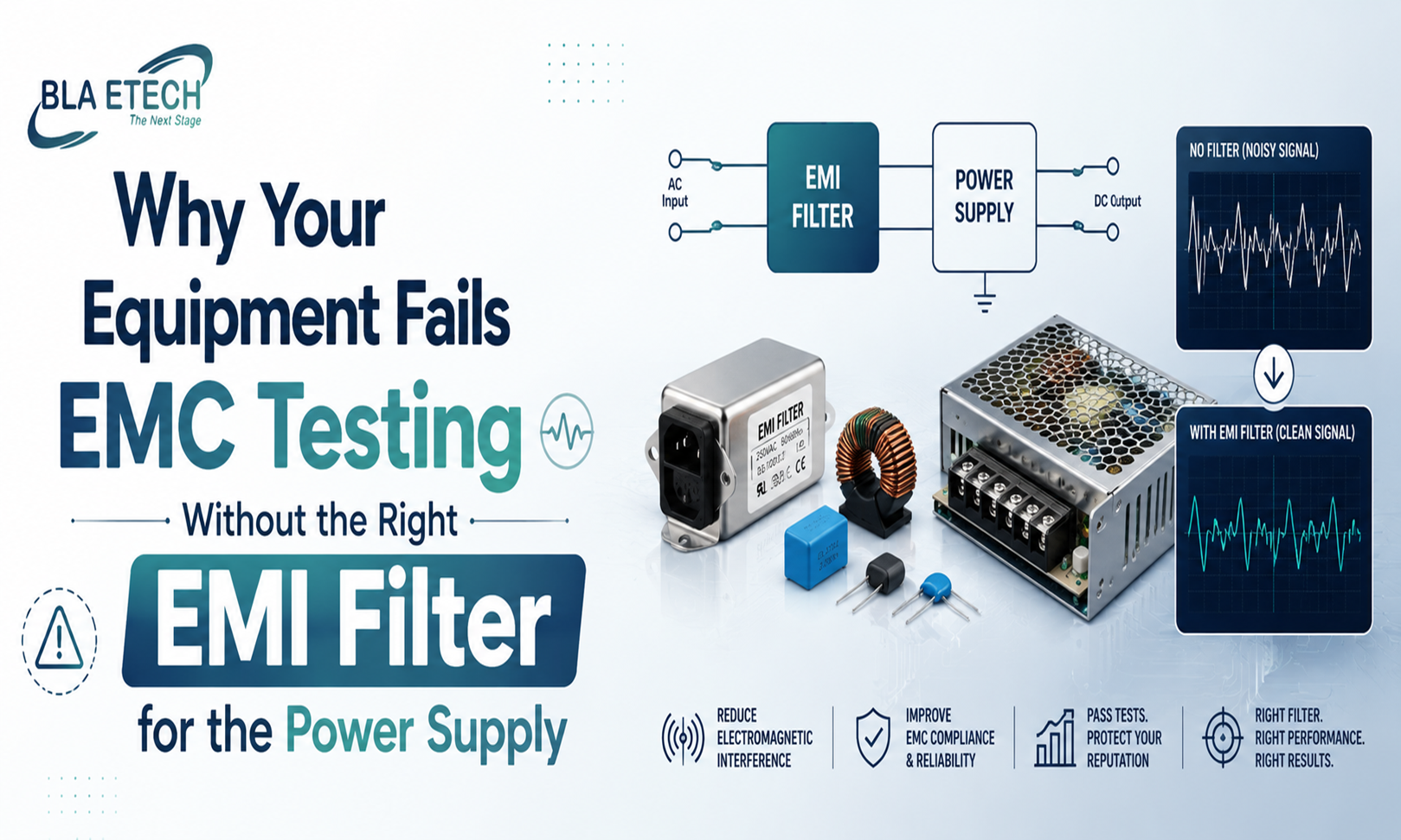
A failure in the EMC test isn't only an inconvenience. For manufacturers operating across Europe, the UK, and the USA, the consequences could be expensive retesting schedules, late launch of new products, non-compliance with regulatory requirements, as well as damaged relations with clients and distributors. This is a source of frustration for numerous engineers, as the issue is usually traced to a single error: the incorrect EMI filtering strategy for the power supply or not having a suitable filtering method in the first place. Knowing why this happens and how to stop it is a matter of knowing the exact parameters EMC tests actually measure and what part the power line filter plays in the outcome. Electromagnetic Compatibility (EMC) testing examines two aspects: the amount of electromagnetic interference (EMI) an equipment emits, as well as how it can withstand interference from outside sources. Regulators across Europe (CE markings in accordance with the EMC Directive), the UK (UKCA marking), as well as those in the United States (FCC Part 15), have to ensure that equipment meets certain thresholds to be able to access industrial or commercial markets legally. In the event of a malfunctioning device, typically, the main culprits are radiated and conducted emissions coming through the power line. High-frequency switch noise produced through power electronics, motor drives, variable frequency drives, and switch-mode power sources travels back to the mains line or radiates out into the air or is transferred to other systems. This is precisely the issue the well-described EMI filter power supply was designed to address. A majority of engineers think that putting in an EMI filter is sufficient to meet the requirements. This is the reason why problems arise. Filters cannot be interchangeable. Every design is based on a particular frequency range, insertion losses profile, impedance characteristic, and load-related characteristics. Filters that are incompatible with the real power supply noise profile could make critical frequency bands not reduced, or in certain instances, cause resonances that increase emissions at a specific frequency. In the case of single-phase equipment with low power, using a common differential common mode filter might suffice. However, for commercial and industrial applications that require three-phase power, the selection of a filter becomes more complicated. Power line filters three-phase models must consider the unbalanced and balanced noise that is present over all three conductors, the neutral line behavior, as well as the harmonic distortion pattern for the loads. The filter you select to be used in a single-phase system cannot perform identically when it is a three-phase setup, regardless of the rated current. Leakage current is yet another important aspect to consider, especially in the case of medical equipment or devices used in situations in which earth bonding is limited. A filter that is designed using a capacitance that is not appropriate to earth could result in leakage current levels that do not comply with security standards, even if the EMC quality is acceptable. The most sensible choice a compliance or design engineer can make is to start working early with an expert EMI filter company rather than choosing components from a catalog towards the end of the design phase. Retrofitting filters to the design of an existing one is feasible; however, it is significantly less efficient than the integration of filtering requirements starting at the conceptual stage. An experienced supplier will analyze the equipment's specific characteristics and frequency of the switch, as well as loading characteristics, environment for installation, and the target market in order to suggest a filter that offers measurable insertion losses over the appropriate frequency range. If a manufacturer is supplying Europe, the UK, and the USA at the same time, it is crucial since the regulatory limitations differ among frameworks. A filter that meets FCC standards may be exposed to the CISPR-based European regulations. BLA Etech has supported the manufacturers in these markets by providing this type of advice for specific applications, which has helped design teams to select and implement the power line filter that will hold up in the face of formal tests. Production equipment for industrial use, automated systems, as well as massive power conversion units that operate using three-phase supply systems produce one of the most complicated EMI patterns that compliance engineers have to deal with. Power line filters three phase models that are used for these purposes must manage higher continuous current ratings that are typically within the 16 to 250A, or more and maintain the same attenuation level under different loads. The actual installation is too. The effectiveness of the filter is greatly diminished when output and input cables are run in parallel, or when grounded connections aren't adequate, and the filter is positioned further away from the entry point of the mains power supply. This is a common reason why these installation elements are ignored, and accounts for a significant percentage of failures that are pre-compliant, even if the filter is designed correctly. Temperature management, along with vibration resistance and the ingress protection rating, also influences the choice of industrial settings. The filter that is effective in a clean lab environment can degrade quickly in the presence of heat, dust, or mechanical vibrations in a live installation. Finding out how to get EMC correctly does not need any guesswork. The process requires an organized method: identify the source of noise, comprehend the regulations for the market you want to target, choose filters that meet the particular conducted and radiated emission pattern, and test the performance by conducting a pre-compliance test prior to making a decision to conduct a formal test. If you are a product team working with strict development deadlines in the UK, Europe, or the USA, involving the most reliable EMI filter company early in the process can be the most efficient method to minimize the chance of testing failure. If your system is in the process of passing EMC testing, or if you're looking into a problem, consulting a qualified expert regarding the power line filtering process is the next best action.What EMC Testing Is Looking For
Why the Wrong Filter Creates the Problem Instead of Solving It
The Benefits of Working with an Expert EMI filter company
Where Three-Phase Filtering Demands Greater Precision
A Practical Path to Compliance


