


Free Samples Available
Qualified projects can receive free product samples
Qualified projects can receive free product samples
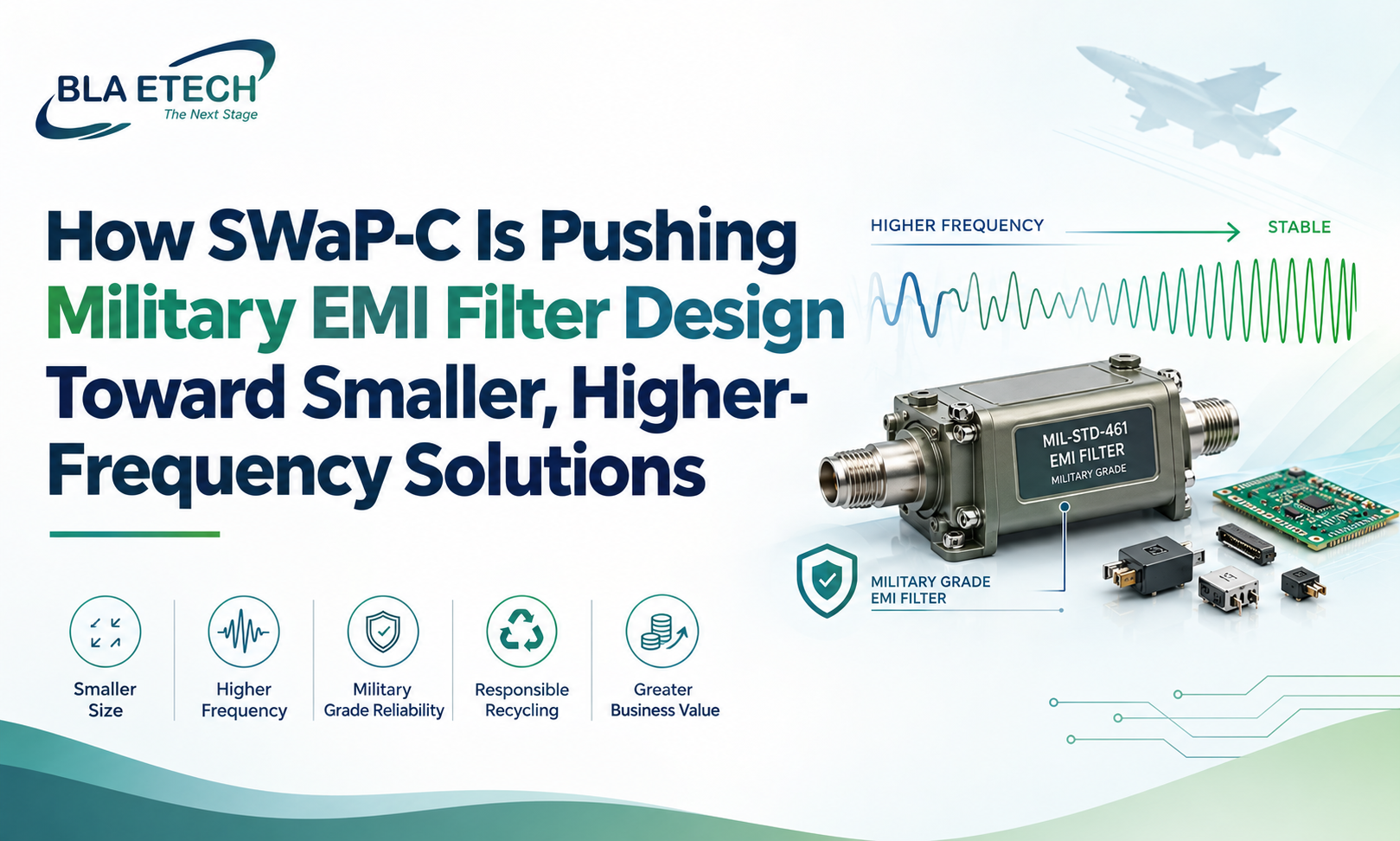
A few years ago, a defense engineer could size an EMI filter mostly by looking at voltage, current, and a target standard. That approach is getting harder to defend. Programs are demanding smaller enclosures, lighter payloads, and lower power draw, all while the switching devices doing the actual power conversion have changed underneath the filter's feet. The result is a design problem that didn't exist in quite this form a decade ago: filters have to get smaller at the exact moment the noise they're fighting has gotten harder to suppress.
This is what people mean when they talk about SWaP-C, size, weight, power, and cost, and it's no longer a slide in a procurement deck. It's a constraint that shows up directly in how a military grade EMI filter gets specified, built, and qualified.
SWaP-C started as a way to talk about platform-level goals: fit more capability into a smaller airframe, extend battery life on a dismounted system, cut the weight budget on a satellite bus. But every one of those goals eventually lands on the power electronics engineer's desk, because power conversion hardware, including its filtering, is one of the heaviest and bulkiest parts of most systems that isn't structural.
When a program office asks for a 30 percent size reduction on a power module, that request doesn't stop at the converter. It reaches the EMI filter too. And a filter can't just be shrunk the way you'd shrink a bracket. Its size is tied directly to its electrical job: attenuating noise at specific frequencies with specific margins. Cut the size carelessly, and you cut the attenuation along with it.
The SWaP-C squeeze would be manageable on its own. What makes it a genuinely different engineering problem is that it's arriving at the same time as a shift in switching devices, from silicon to wide-bandgap semiconductors like gallium nitride and silicon carbide.
These devices are exactly what enable the size and efficiency gains SWaP-C programs want. They switch faster and handle higher voltages with less loss. But that speed has a cost on the EMI side. Wide-bandgap devices can switch fast enough that the resulting harmonic energy pushes well past where a comparable silicon design would have stopped mattering, forcing filters to stay effective at frequencies that used to be someone else's problem.
There's a subtler shift too, one that catches experienced engineers off guard. In older silicon-based designs, differential-mode noise tended to dominate at lower frequencies, with common-mode noise taking over higher up the spectrum. That pattern doesn't hold reliably anymore. Because wide-bandgap devices switch so quickly, common-mode noise can dominate even at frequencies where it used to be a minor contributor, and this shows up even in smaller, lower-power converters, not just high-power systems. If your filtering strategy still assumes the old split between differential and common-mode dominance, you're designing against yesterday's noise profile.
The mechanism behind this is worth understanding rather than just accepting. Fast-switching gallium nitride devices can produce voltage transition rates far steeper than older silicon parts, and those steep transitions drive common-mode current through parasitic capacitances that were barely relevant before. That current has to go somewhere, and increasingly, it's the filter's job to catch it.
Here's where SWaP-C and wide-bandgap switching collide in a way that can't be engineered around with clever packaging alone. Common-mode filtering has traditionally relied on chokes that are physically large because the amount of capacitance you're allowed to use to ground is capped by touch-current safety limits. You can't just add more Y-capacitance to compensate for a smaller choke. That limit doesn't move because a program wants a lighter box.
This is pushing the industry to look past the traditional passive-only approach. Active EMI filtering, where circuitry actively cancels common-mode noise instead of relying solely on bulky passive components, is gaining attention specifically because it offers a path to smaller filter volume without simply ignoring the attenuation requirement. It's not a universal answer yet, and it's not appropriate for every platform or budget, but it reflects where serious filter design is heading as SWaP-C pressure holds steady.
For an engineer sizing a filter today, the honest takeaway is this: a smaller footprint and a harder noise environment are now standard parts of the same request, not two separate problems you can solve independently.
A few practical shifts follow from all of this:
Don't spec a filter based on switching frequency alone. Ask what the actual dV/dt and di/dt look like at the device level, since two converters at the same switching frequency can generate very different noise depending on the semiconductor technology.
Revisit assumptions about common-mode versus differential-mode dominance for any design that has moved from silicon to gallium nitride or silicon carbide, rather than reusing an old filter topology.
Treat filter volume as a design output, not a fixed input. If a program is demanding smaller and lighter, that target has to be negotiated against the attenuation margin early, not discovered during EMC testing.
Loop in your EMI filter company or manufacturer earlier in the design cycle. A supplier that understands wide-bandgap noise behavior can help avoid undersizing a filter for the actual harmonic content, a far more expensive mistake to catch late.
SWaP-C isn't going away, and neither is the industry's move toward gallium nitride and silicon carbide power electronics. Together, they mean military grade EMI filters can no longer be treated as a catalog afterthought bolted on once the power stage is finalized. The filter has become part of the power electronics design itself, shaped by the same switching decisions that determine efficiency and size elsewhere in the system.
For engineers and procurement teams navigating this, the practical move is to bring filtering into the conversation early and work with a manufacturer who can discuss the actual noise profile of your converter, not just its voltage and current ratings. BLA Etech works across military and custom EMI filtering applications, and conversations like these, about what a specific wide-bandgap design actually needs from its filter, are exactly where an experienced EMIfilters manufacturer earns its place on a program rather than just filling a line item


