


Free Samples Available
Qualified projects can receive free product samples
Qualified projects can receive free product samples
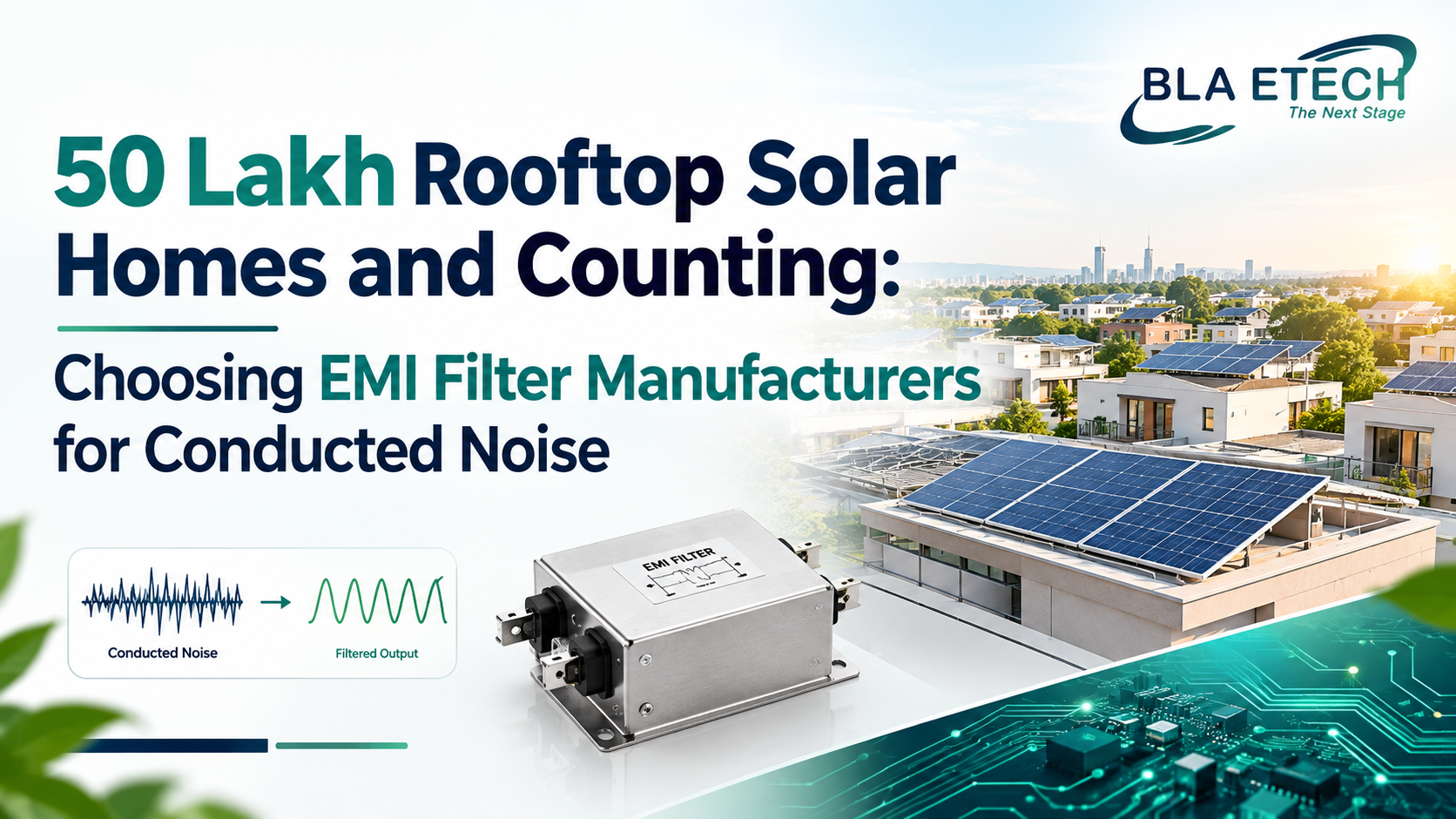
India's rooftop solar programme has quietly become one of the largest electronics rollouts in the country. PM Surya Ghar crossed 50.06 lakh households on 4 August 2026, and daily installations climbed from 5,038 in October 2025 to about 16,328 in July 2026, roughly 3.2 times faster. Every one of those homes gets an inverter that switches thousands of times a second, and each switching edge can push noise back into household wiring. For inverter makers, installers, and OEM engineers, that raises a practical question: how do you choose among single-phase EMI filter manufacturers when the product must pass emission tests and survive years on a rooftop?
The answer is rarely a catalogue part picked at the last minute. Many teams find that standard parts cover most of the design, while the last few decibels or the last few millimetres call for custom single phase EMI filters. This guide explains where conducted noise comes from in a home solar system, what to ask a supplier, and how to brief them so the first sample lands close to the final.
Most Indian homes are supplied through a single-phase connection, and residential solar systems are usually a few kilowatts, with the programme's feasibility waiver applying up to 10 kW. Inside the inverter, fast switching excites parasitic capacitance between the panel frame, the converter, and earth, which drives common-mode current onto the wiring. Research on single-phase PV inverters shows that this noise can enter the grid and disturb other devices on the same line, so both common-mode and differential-mode paths need control. A passive filter on the output is a standard remedy, and published tests often benchmark results against limits such as EN 55022 Class B, the residential category.
By early October 2026 the programme had recorded 50,99,781 rooftop installations and 17,855 MW of capacity, compared with 7.94 lakh installations in the whole previous decade. More than 37,000 vendors are registered, and the target is one crore homes. At that pace, even a small share of units that fail an emission test or cause nuisance interference turns into a large number of callbacks. Choosing the filter late, or choosing on price alone, becomes an expensive habit.
Score each supplier from 0 to 2 on these checks:
Range breadth. Do they offer general-purpose, high-performance and dual-stage single-phase series, so you can move up a tier without changing vendors?
Current rating at real temperature. Ratings are quoted at a stated ambient, and a sealed rooftop enclosure runs hotter than a lab bench, so ask for derating data.
Leakage current. Panels already add leakage to earth, so ask for the filter's figure at stated voltage and frequency.
Insertion loss curves. Request common-mode and differential-mode data and the test setup behind them.
Mechanical fit. Check terminals, footprint and mounting against your enclosure.
Documentation by part number. Datasheets, approvals and test reports should match the exact model.
Sample speed and engineering support. Ask who will review your scan and how fast a revised sample arrives.
A supplier scoring below 10 out of 14 deserves a harder look before you commit volumes.
First, a standard part passes differential-mode limits but fails in one common-mode band. Second, enclosure space or terminal orientation forces awkward mechanical workarounds. Third, your leakage budget is tighter than any catalogue option allows. In these cases, custom single phase EMI filters can fix the problem at the source, instead of stacking extra ferrites and capacitors onto a finished design.
One caution: insertion loss is usually measured in a controlled 50 ohm setup, while real grid impedance varies, and field studies show that this variation changes AC-side filter performance. Treat the datasheet curve as a comparison tool, then confirm with a conducted emission scan on your own inverter.
Send these details with your request:
Rated voltage, load current, and maximum enclosure temperature
Inverter topology, switching frequency, and whether it is transformerless
Your measured conducted emission scan and the limit class you are targeting
Leakage current budget
Size, terminal type, and mounting constraints
Expected volumes and timeline
Incomplete briefs are the main reason custom projects run through several sample rounds.
The first is ordering custom single phase EMI filters before running any scan, which turns the specification into a guess. The second is sizing the filter to the nameplate current while ignoring enclosure heat, so the part runs closer to its limit than planned. The third is validating only on a clean lab supply and then meeting a different grid impedance in the field. All three are cheaper to fix on a bench than on a roof, and fixing them protects what households were promised: years of quiet, trouble-free generation without nuisance interference on the same wiring.
BLA Etech is an Indian EMI filter manufacturer offering standard and customised filters across ratings from 1 A to 2,500 A, and its single-phase range spans general-purpose, high-performance and dual-stage designs. Solar inverter EMI/EMC is among the applications it addresses, which makes the scorecard above a fair way to test it, or any other supplier, against your own requirements. Ask BLA Etech for part-number test data and a leakage figure, just as you would from anyone else on your shortlist.
The rooftop solar boom means thousands of new inverters enter homes every day, and conducted noise is one of the quietest ways for a product to fail. Run a pre-compliance scan, score two or three suppliers with the checklist, and share a complete brief if a standard part cannot close the gap. Teams that do this early usually avoid repeat test cycles. If you want a specialist view on your design, BLA Etech can review your scan and recommend either a standard series or a custom variant.


