


Free Samples Available
Qualified projects can receive free product samples
Qualified projects can receive free product samples
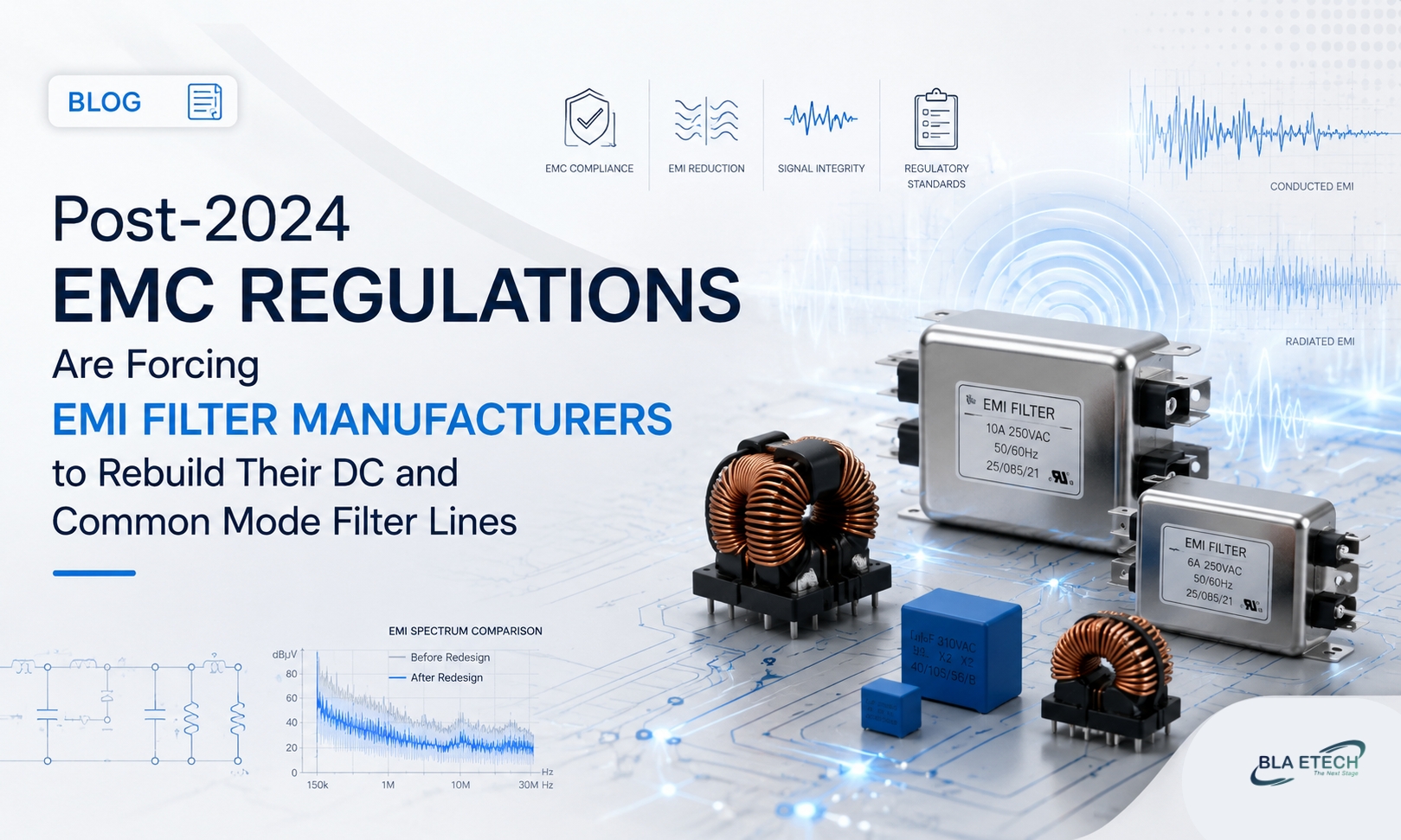
The landscape of compliance for electromagnetic compatibility has evolved dramatically in the past two years, more than over the past decade. In Europe,e as well as in the UK and US, new enforcers' frameworks, a tightening of harmonic limits, as well as the rapid growth of power-intensive DC applications have rendered older filtering designs completely outdated. In the case of EMI filter manufacturers, their response to the changes hasn't been progressive. Whole product lines are being reconstructed from the ground up, starting from scratch.
Knowing why is about looking at what's changed in the last few years and how it affects the procurement and engineering teams, and system integrators who are defining the filters that are needed for applications in real time right today.
The EU's EMC Directive 2014/30/EU remains the basis for the regulation of equipment that is placed within the European market. However, norms that are harmonised under it are being revised in ways that affect significantly in the real world. Standards like EN 55332, EN 61000-6-3, and EN 61000-6-4 reflect more stringent conductivity limits for emissions across a wider frequency, especially those used for the residential and industrial environments.
Additionally, the UK's post-Brexit EMC Regulations (SI 2016/1091) are in full alignment with EU Designated Standards, meaning producers cannot use a distinct specification to be able to compete in Great Britain versus EEA markets. CE marks have been accepted throughout Great Britain for most EMC-regulated products, yet the specifications for the technical aspects have increased regardless of which mark is utilized.
Within the US, FCC Part 15 Subpart B is still in effect to regulate radiating and conductor radiations from non-intentional radiators. With the frequency of switching in power conversion devices have increased as well as power density have risen as well, the Class A and B filter configurations aren't able to keep up with the limits once possible in the first generation of designs.
In the end, an item that was certified as conforming by a standard that was harmonised five years ago could not meet the current version of the standard. Manufacturers, this is not an issue with the documentation. This is an engineering issue.
The rapid growth of EV quick charging infrastructure and battery storage systems, as well as solar arrays with inverters, has led to a rise in the demand for DC EMI filters that can operate with current and voltage rates that conventional AC-based designs did not have the capacity to handle.
DC fast chargers currently run at speeds of up to 1000 VDC or higher, while grid-tied converters produce high-frequency switching transients over vast spectral areas. These emissions from systems pass through the power bus as well as through the chassis. That implies that the DC EMI filter must handle differential mode as well as common mode noises simultaneously at frequencies that older filters are unable to handle.
Conformity with IEC/EN61851-23 to charge EVs in the charging infrastructure, as well as the larger IEC 61000 emission and immunity series, calls for filters designed to work in DC environments and are not designed to AC filter structures. This has led to a radical reconsideration of the inductance value as well as the core materials used, the capacitance ratings, and leakage current limitations, which are all contained in ever-smaller sizes.
Common mode EMI filter effectiveness has been one of the more scrutinised aspects under the latest EMC standards, and with good reason. Common mode currents that are high-frequency and created by switching converter motor drives, as well as inverter-based systems, are extremely difficult to eliminate when they are present on lengthy cables or in enclosures for equipment.
For motor drive applications in motor drive applications, EN 61800-3 defines emission limitations for drive systems using power sources for both the first and second conditions, and for common mode currents that go over the limits can cause problems with compliance, but can also cause real operating issues like elevated bearing currents, premature breakage, or interruption to nearby instruments. The term Common mode EMI filter for these types of applications can't simply achieve a certain limit for a particular frequency. It should provide constant attenuation throughout the entire conducted emission frequency, between 150 kHz and 30 MHz. All while ensuring stable operation across the entire temperature range and load profiles of the device.
Manufacturers that previously had wide ranges of products are realizing that the standard mode choke components, capacitor films, and Y-capacitor designs that previously fulfilled test criteria have become insufficient. Custom-designed wound elements, multi-stage topologies, as well as inductance curves for specific applications have become standard specifications and not just premium alternatives.
The implications are simple that filter selection cannot rely more on datasheets from catalogs for attenuation curves on their own. Engineers designing EMI filters in the new design should work with designers who understand the regulatory framework at present rather than as it was in the days when the filter was initially developed.
It is important to work with companies that are able to provide performance information against currently harmonised standards that understand the distinction between derated and rated capacitor performance when subjected to DC bias, and are able to provide certification documents across EU, UK, and FCC specifications from one product model.
BLA Etech designs and supplies EMI filters. They include DC EMI filter and Common mode EMI filter solutions. They also have a product creation process that's aligned to today's EMC regulations in the European, UK, and US markets. Engineers who are navigating the compliance environment post-2024, having a technologically established supplier from the very beginning phases of development is not an option anymore. The requirements of the regulatory framework will increase in severity, so filters that can meet the requirements must be constructed in line with the requirements.
If you're defining EMI filtering solutions to be used in your current or future project, and require guidance regarding solutions that are compliant, our team at BLA Etech will provide you with application-specific help from design reviews to approval.


