


Free Samples Available
Qualified projects can receive free product samples
Qualified projects can receive free product samples
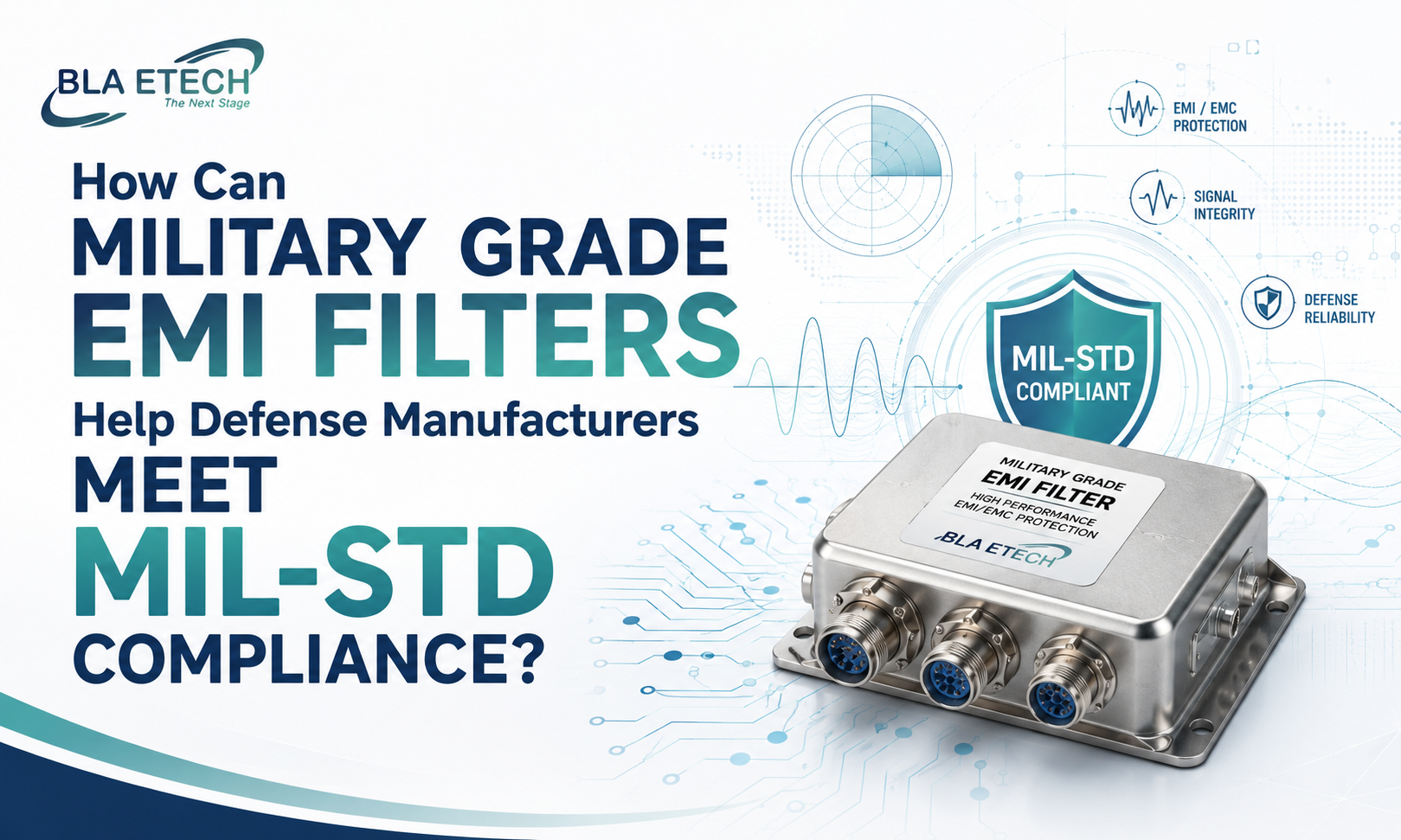
Defense electronics operate in some of the most electromagnetically hostile environments on the planet. A ground vehicle communicating with a command post, a naval radar system sharing power infrastructure with weapons control, or an avionics platform managing navigation, communications, and countermeasures simultaneously, each of these scenarios creates conditions where uncontrolled electromagnetic interference can compromise mission outcomes and, in the worst cases, cost lives. Military grade EMI filters are one of the primary engineering tools used to manage this risk, and understanding how they align with MIL-STD compliance requirements is fundamental knowledge for any defense manufacturer or procurement organization.
MIL-STD-461 applies to mission-critical electronics systems used by the Department of Defense, and meeting it is nonnegotiable for any supplier in the defense procurement chain. The standard covers four distinct electromagnetic domains that every piece of defense electronics must address.
MIL-STD-461 defines requirements across conducted emissions, what equipment puts out on power lines; conducted susceptibility, what it can withstand from noisy power without failure; radiated emissions, the electromagnetic field it generates into the surrounding environment; and radiated susceptibility, the device's tolerance to external radiated electromagnetic interference.
Each of these categories represents a specific failure pathway. A system that generates excessive conducted emissions will corrupt the power bus shared with adjacent equipment. A system with poor conducted susceptibility will degrade or fail when operating near generators, actuators, or power conversion equipment that produces noisy power. Radiated emissions create interference fields that affect sensors, communications, and navigation. Radiated susceptibility determines whether a system survives in proximity to radar transmitters, electronic warfare platforms, or high-power radio systems.
EMI filters that meet MIL-STD-461G must be able to withstand susceptibility tests without failure or degradation, and must have insertion loss high enough to ensure compliance without interfering with normal operation. This dual requirement, attenuation sufficient to pass emission limits and robustness sufficient to survive susceptibility testing, defines what separates a genuine military grade EMI filter from a commercial-grade alternative that has simply been labeled for defense use.
Not every compliance problem requires the same filter solution. Understanding how different filter types address different MIL-STD-461 requirements helps engineers select and specify filters that solve actual compliance problems rather than adding components that provide marginal benefit.
Conducted emissions mitigation is where electric power filters on the input line play the most direct role. Switching power supplies, DC-DC converters, and motor controllers all generate high-frequency current that propagates back along the power supply line. The compliance process involves rigorous testing across conducted emissions, radiated emissions, conducted susceptibility, and radiated susceptibility, assessing how much EMI a system releases and receives, and how well it blocks these signals. Input line filters that combine common-mode inductors, differential-mode capacitors, and damping networks reduce this return-path noise to levels within MIL-STD-461 CE102 limits.
Power line susceptibility requires filters that protect the internal circuitry of a system from disturbances on the supply bus. Military grade EMI filters are designed with high precision and reliability to withstand extreme temperatures, high voltages, and harsh line conditions, which is critical in environments where the supply bus may carry transients from weapons firing events, engine starting loads, or other high-energy transitions that would destroy or latch up unprotected electronics.
Radiated emissions control is more complex and involves both the filter and the overall system integration. Military grade EMI filters reduce the common-mode currents on power and signal cabling that act as antennas for radiated emissions. When filters are correctly bonded to chassis ground and installed at the point where cables enter or exit a shielded enclosure, they contribute significantly to the attenuation of radiated fields.
The physical and operational demands placed on defense equipment create filter requirements that commercial-grade components are not designed to survive. Military filtering applications require designs that can withstand shock and vibration across wide temperature ranges, typically from -40°C to +85°C, while maintaining consistent electrical performance. A commercial filter that meets its insertion loss specification at room temperature in a stable laboratory environment may drift significantly when subjected to thermal cycling, vibration profiles, and altitude changes associated with airborne or naval deployment.
Military-grade electronics are subjected to environmental stress screening and redundancy measures to ensure continued operation even if one conversion stage fails, and are tested to standards including MIL-STD-202 alongside MIL-STD-461 for electromagnetic compatibility. MIL-STD-202 covers the environmental and mechanical test methods applied to passive components, including filters, meaning a compliant military filter must survive vibration, thermal shock, salt atmosphere, and humidity testing in addition to its electrical performance requirements.
The combination of electrical performance, environmental durability, and documentation traceability required for military certification represents a design and manufacturing investment that commercial filters do not carry. For a defense manufacturer facing contract compliance requirements, substituting commercial components creates both technical risk and contractual exposure that is rarely worth the short-term cost savings.
Selecting a military grade EMI filter that meets the relevant specifications on its datasheet is a necessary condition for MIL-STD compliance, but not a sufficient one. How the filter is integrated into the system determines whether its specified performance is realized in practice.
Grounding and bonding are the most critical integration factors. An electric power filter mounted with inadequate chassis bonding, or installed with a ground connection that introduces impedance at the frequencies of interest, will not achieve the attenuation its datasheet specifies. The bond between the filter body and the chassis must be low-impedance across the frequency range being addressed, typically achieved through direct metallic contact with clean, unpainted mating surfaces and a short, wide ground strap where direct bonding is not possible.
Cable routing after the filter is equally important. If the filtered cable is routed in proximity to unfiltered cables carrying the noise currents the filter was installed to address, coupling between those cables partially defeats the filter's purpose. Physical separation of filtered and unfiltered cabling, or the use of shielded cable post-filter where separation is not achievable, maintains the effectiveness of the filter installation.
Meeting MIL-STD-461 compliance is not a documentation exercise. It is an engineering outcome that depends on selecting components designed for the relevant requirements, integrating them correctly, and validating performance through rigorous testing before equipment reaches the qualification phase. Military grade EMI filters are a central element of that process, addressing conducted and radiated emission limits and protecting systems from the susceptibility conditions they will encounter in operational environments.
BLA Etech designs electric power filters and military grade EMI filter solutions for defense manufacturers navigating these requirements, bringing application engineering expertise that bridges the gap between component specification and certified system compliance. For organizations managing MIL-STD-461 programmes, the right filter selection and integration approach is most productively addressed early in the design cycle, before compliance testing reveals problems that are expensive to fix.


