


Free Samples Available
Qualified projects can receive free product samples
Qualified projects can receive free product samples
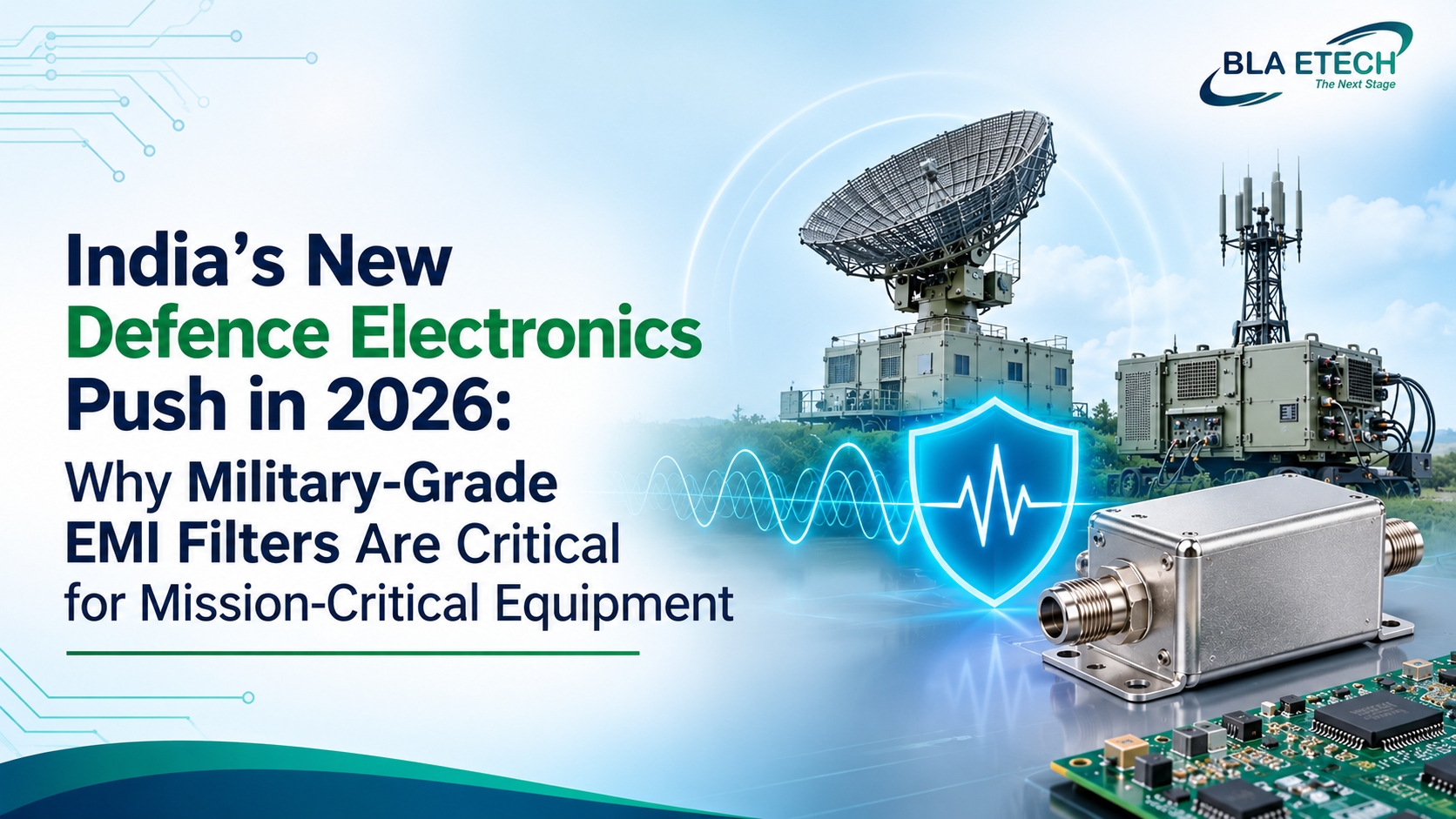
Every radar, radio, and flight computer depends on clean power. An EMI filter sits where mains or supply lines enter the equipment and blocks unwanted electrical noise from getting in or leaking out. Military grade EMI filters are built and tested to do this under shock, heat, vibration and tight electromagnetic limits, which is why they matter more each year as India builds more of its own defence electronics. This article covers what is driving that growth, how these filters work, and how to specify them correctly.
India’s defence production reached a record ₹1.78 lakh crore in FY 2025-26, up 15.6% from ₹1.54 lakh crore the year before, according to the Ministry of Defence. Defence exports hit ₹38,424 crore, against ₹23,622 crore in 2024-25. The private sector contributed about 24% of production, worth roughly ₹42,000 crore.
Policy is pushing in the same direction. Ten Positive Indigenisation Lists covering 5,521 items had been notified by May 2026, and the Srijan platform reportedly connects over 41,000 vendors with 2.7 lakh products. Government targets mention ₹3 lakh crore in production and ₹50,000 crore in exports in the coming years.
For component makers, this means more Indian-built radars, communication sets, avionics and naval electronics, each of which needs reliable EMI control designed from the start.
Electronic equipment creates noise. Switching power supplies, motor drives, and fast digital circuits push unwanted high-frequency currents onto power lines. That noise travels two ways:
Conducted noise moves along wires, either between line and neutral (differential mode) or between lines and ground (common mode).
Radiated noise travels through the air and is handled mostly by shielding and layout.
A power-line EMI filter is a low-pass network of inductors and capacitors. It lets 50 Hz or 400 Hz power through and attenuates the higher frequencies. Its performance is measured as insertion loss in decibels across a frequency range.
In consumer products, EMI failures usually mean a buzzing speaker. In defence systems, the stakes are different:
Sensitive receivers. Noise on a supply line can raise the receiver floor of a radar or communication set and reduce detection range.
Dense platforms. Aircraft, ships, and vehicles pack many transmitters and sensors close together, so interference from one unit can disturb another.
Data integrity. Noise on power rails can corrupt signals in flight controllers and mission computers.
Emission limits. Equipment must stay within strict conducted emission limits so it does not disturb neighbouring systems.
Standards such as MIL-STD-461 set emission and susceptibility requirements for equipment, and MIL-STD-220 defines how filter insertion loss is measured. India’s JSS 55555 covers environmental testing. A filter that looks fine on a bench can fail once vibration and temperature extremes are added.
The phrase is used loosely, so ask for evidence. A filter described this way should come with:
Insertion loss data measured to a recognised method, across the full frequency band you need.
Environmental test reports for temperature range, vibration, shock, and humidity, matched to your platform.
Rugged construction, such as sealed or potted cases and secure terminations.
Controlled leakage current where personnel safety or medical-style limits apply.
Traceable materials and documentation for audits and qualification.
If a supplier cannot supply this, the label is only marketing.
Off-the-shelf filters work for general use, but defence units often have tight space, odd connectors, and specific noise problems. Custom single phase EMI filters are worth considering when you have any of these:
BLA Etech, a Delhi-based manufacturer, lists military filters, HEMP filters, and customised single-phase and three-phase filters among its products and publishes a standard single-phase series for general and medical use. When you approach any manufacturer, bring your measured noise data and target standard, since that is what a custom design is built around.
Step 1: Define the standard. Identify the limits you must meet, such as the relevant MIL-STD-461 requirements or customer-specific tests.
Step 2: Measure the baseline. Test your prototype without a filter to see where emissions exceed the limit and by how much.
Step 3: Write the filter specification. Include voltage, current, frequency of supply, required attenuation band, leakage current, temperature range, size, and termination.
Step 4: Prototype and test in the real unit. Filter performance depends on mounting, grounding, and cable layout, not only on the part itself.
Step 5: Qualify and document. Keep test reports ready for acceptance and audit.
BLA Etech suggests involving the filter supplier early in design, since changing a filter late can mean re-testing the whole unit.
Indigenisation lists are not just policy. They affect lead times, documentation, and support. A domestic supplier can often iterate on a design faster, accept smaller custom volumes and respond when a test fails on a Friday afternoon. That matters for development programmes with changing specifications.
Adding the filter last. It is much harder to fix emissions after the enclosure is frozen.
Poor grounding. A good filter with a long, thin ground lead loses performance at high frequency.
Choosing by current rating only. Insertion loss, leakage and environmental ratings matter just as much.
Ignoring the load. Filter behaviour changes with source and load impedance.
Skipping documentation. Missing test reports can delay qualification.
India’s defence electronics ecosystem is growing quickly, with record production and exports and policy support for domestic suppliers. Behind every radar, radio and avionics box is a power line that must stay clean. Military grade EMI filters, selected with real test data and matched to the equipment, protect performance when it matters most. Where standard parts fall short, a custom design built around your measured noise is often the faster route to compliance.
Your next step is simple. Measure the conducted emissions of your current prototype, list your voltage, current, size and environmental needs, and share them with a filter manufacturer before the design freezes. If you are working on a defence or industrial project, the BLA Etech team can discuss standard and customised options against your specification.


