


Free Samples Available
Qualified projects can receive free product samples
Qualified projects can receive free product samples
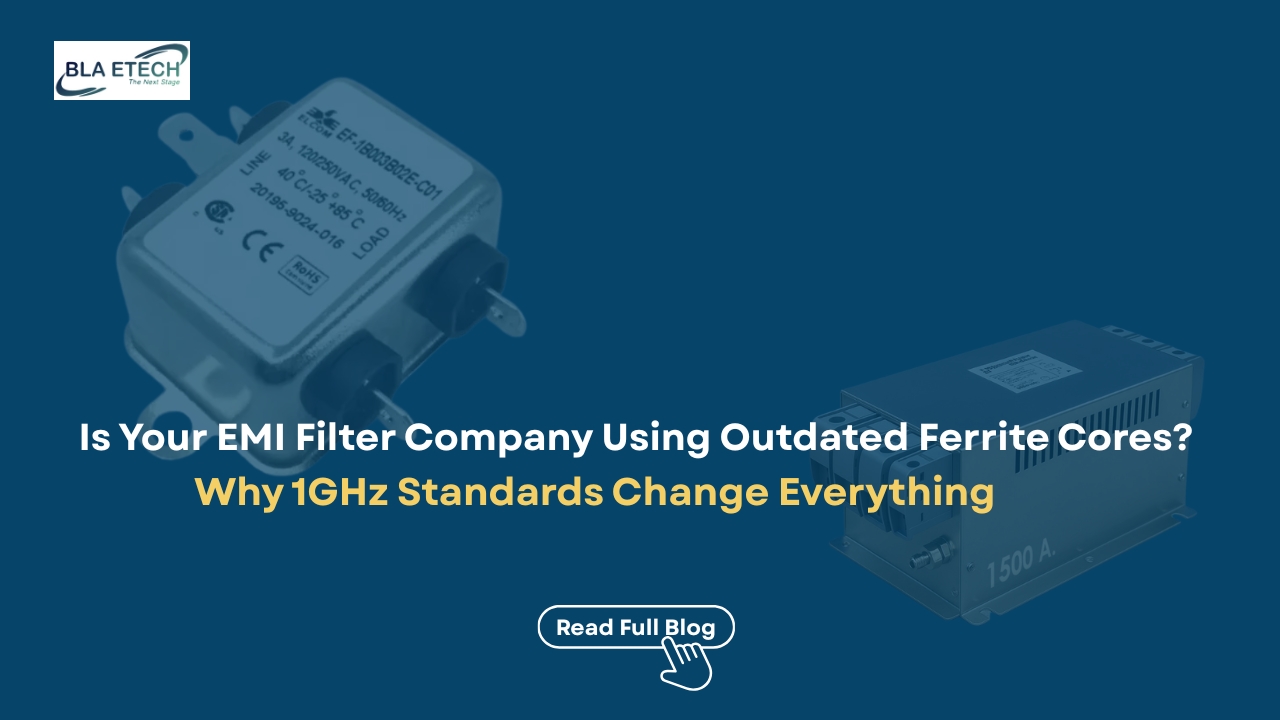
The electromagnetic hindrance geography has shifted dramatically, yet numerous manufacturers across Europe, the UK, and the USA continue operating with ferrite core technology designed for historical reasons. When your outfit fails compliance testing or experiences unexplained performance decline, the malefactor frequently lies in EMI Filter factors that simply were not designed for modern high-frequency surroundings.
BLA Etech has identified a critical gap in the request that numerous businesses investing in EMI filters discover too late that their pollutants perform brilliantly at 100 MHz but collapse entirely at 1 GHz. This is not just a specialized vexation, it's a compliance agony that delays product launches, triggers expensive redesigns, and damages hard- earned reports.
Traditional ferrite accoutrements hit a performance wall between 300 and 500 MHz. The permeability that makes them effective at lower frequencies becomes a liability as you approach gigahertz ranges. What happens? Your DC EMI filter that tested impeccably in the lab suddenly allows switching noise to blunder through in real- world operations. Power transformers should operate fairly rather than radiate interference that disrupts nearby electronics.
Manufacturing installations in Germany, France, and across the Netherlands have encountered this exact script. masterminds specify pollutants based on datasheet performance at standard test frequency, without realizing that their factual operating terrain, with timepiece pets, switching frequency, and harmonious content extending well into the 1 GHz range, exists in a fully different performance zone.
The abecedarian issue stems from material drugs. Conventional manganese-zinc and nickel- zinc ferrites parade, adding losses at advanced frequency. While some loss is salutary for damping resonances, inordinate loss means the core can no longer give the inductive impedance demanded for effective filtering. Your EMI filter company might be using cores optimized for CISPR 25 or DO- 160 testing at standard frequency, fully overlooking the extended frequency conditions of ultramodern switched- mode power inventories, RF dispatches outfit, and high- speed digital systems.
Regulatory bodies have not stood still. The rearmost emigration norms, particularly for automotive, aerospace, and telecommunications operations, extend dimension conditions well beyond traditional limits. CISPR 25 Class 5 testing now routinely examines conducted emissions up to 1 GHz. Military specifications increasingly dictate performance verification across extended frequency ranges. However, you are basically bringing a cutter to a gunfight, If your Bespoke EMI Filter was designed using ferrite cores optimized for 30- 200 MHz performance.
Consider the counteraccusations for power electronics manufacturers in the USA. A DC- DC motor operating at 500kHz does not just produce emissions at its abecedarian switching frequency. The square- surge nature of switching waveforms generates rich harmonious content; the 5th harmonious sits at 2.5 MHz, the 50th at 25 MHz, and the 500th at 250 MHz. But that is still not the complete picture. Rise time- related emigrations, parasitic resonances, and intermodulation products push energy content significantly advanced. Without ferrite cores able to maintain performance above 1 GHz, your Filter becomes precipitously transparent to these advanced- frequency factors.
BLA Etech's engineering platoon has conducted extensive testing across multiple ferrite accoutrements and shapes. The results constantly demonstrate that material selection must align with the factual frequency content of the hindrance being suppressed, not just the abecedarian operating frequency of the outfit.
Advanced ferrite phrasings designed for gigahertz performance use different liquid structures and dopant combinations. These accoutrements maintain usable permeability and respectable loss characteristics across extended frequency ranges. Rather than flaunting the sharp performance roll- off typical of heritage accoutrements, they give further gradational impedance transitions that remain effective where traditional ferrites have formerly failed.
For operations taking DC EMI filter results, this becomes particularly critical. DC pollutants must present high impedance to discriminational and common- mode noise while maintaining minimum resistance to the DC path. At advanced frequencies, parasitic capacitances within the Filter structure can produce unintended bypass paths that master the filtering function entirely. ultramodern core accoutrements, when duly enforced in optimized shapes, help maintain the intended Filter response across the full frequency diapason of concern.
Masterminds in the UK working with high-reliability operations, medical bias, road signaling, and artificial robotization have learned this assignment through painful experience. A Filter that meets introductory CE marking conditions might still prove shy for installations with significantly high-frequency ambient fields or critical vulnerability enterprises. Specifying factors grounded solely on cost or vacuity, without considering extended-frequency performance, sets projects up for premature failures.
Off- the- shelf Filter results inescapably involve negotiations. A roster EMI filter company designs for maximum request reach, targeting the broadest possible operation range rather than optimizing for specific use cases. This approach worked nicely when most operations operated within analogous frequency ranges and faced similar hindrance challenges. That period has definitely ended.
Bespoke EMI Filter design starts with a detailed characterization of the factual noise terrain and emissions profile. BLA Etech's process includes diapason analysis of the outfit under test, identification of specific problematic frequency, evaluation of both conducted and radiated coupling paths, and dimensions of source and cargo impedances that dramatically affect Filter performance. Only after completing this characterization does the factual Filter design begin.
This methodology proves especially precious for guests across Europe and the USA dealing with unusual operating conditions, extreme temperatures, high- altitude aerospace operations, presence of sharp atmospheres, or operation near high- power RF transmitters. Standard pollutants designed for benign laboratory conditions infrequently survive long- term deployment in these grueling surroundings.
The ferrite core selection process becomes further nuanced in custom designs. Rather than defaulting to a single material across all factors, BLA Etech's masterminds might specify different cores for common-mode versus discriminational-mode inductors, or use cold-blooded designs combining multiple ferrite grades to optimize performance across distinct frequency bands. This position of optimization simply is not possible with standard roster products.
Laboratory testing under controlled conditions provides precious original data, but real- world confirmation remains essential. BLA Etech conducts emigration testing using calibrated dimension outfit traceable to public norms. This testing extends across the full frequency range applicable to the operation, generally from 150kHz to at least 1 GHz, and frequently advanced for specific operations.
Manufacturers in Spain, Italy, and throughout Scandinavia have discovered that pollutants meeting introductory specifications can still fail when installed in a factual outfit due to installation issues, resting issues, or unanticipated relations with other system factors. A comprehensive approach to EMI filtering addresses not just the Filter element itself, but the entire installation methodology, string routing, connector selection, and system- position grounding armature.
The transition to 1GHz-able ferrite cores represents more than just an element upgrade; it's a meridian shift in how filtering results are conceived, designed, and validated. Companies continuing to rely on heritage approaches find themselves increasingly unfit to meet ultramodern compliance conditions or achieve the performance their guests anticipate.
The electromagnetic terrain continues growing more complex and demanding. Equipment operating frequency keeps climbing, nonsupervisory conditions come more strict, and the penalties for non-compliance, fiscal, reputational, and functional, continue to add. Partnering with an EMI filter company that understands these evolving challenges and possesses the engineering depth to address them makes the difference between products that succeed and systems that fail.
BLA Etech invites masterminds and procurement specialists across Europe, the UK, and the USA to witness what truly optimized EMI filtering can achieve. Whether you need a custom DC EMI filter for a technical power operation, complete system- position filtering for complex installations, or expert discussion on emigration compliance strategies, the engineering platoon stands ready to help. Do not let outdated ferrite core technology compromise your coming design, reach out now to bandy how ultramodern filtering results can break your most grueling EMI problems and ensure your products meet every performance and compliance demand they'll face in the real world.


