


Free Samples Available
Qualified projects can receive free product samples
Qualified projects can receive free product samples
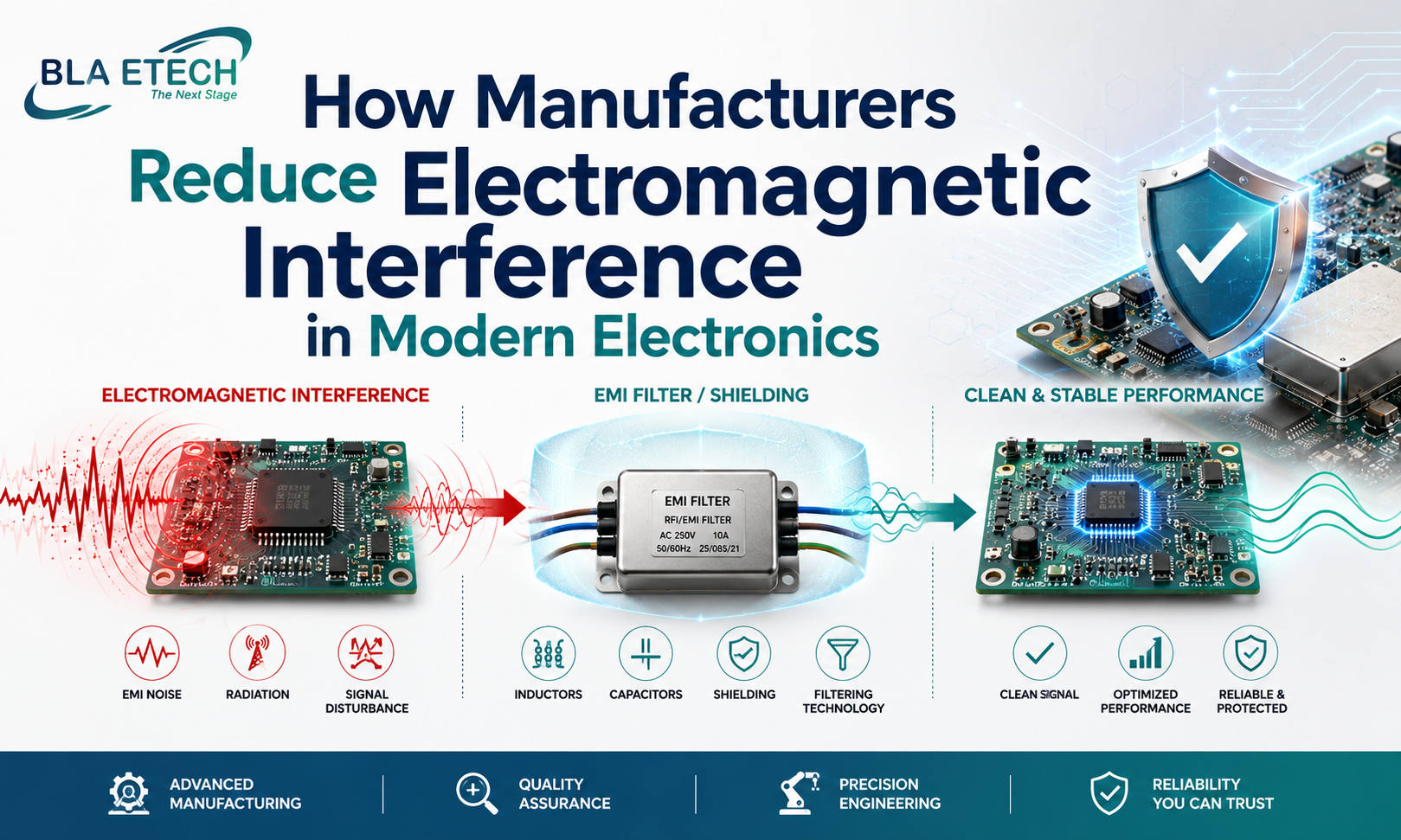
Everyone working in the field of power electronics understands the frustration of a product that works perfectly on the bench but fails compliance tests. Electromagnetic interference, or EMI, is often the invisible culprit. As electronic devices become more complex and faster, the task of managing EMI has evolved from an optional checkbox at the end of the process to an essential design consideration. Companies all over Europe, as well as the UK and the USA, are investing more in filtering strategies that ensure the product's performance as well as its regulatory status.
Industry standards and regulators have issued strict electromagnetic compatibility guidelines. Manufacturers must include EMI filters in their products to ensure that they are compliant with the standards. Within the UK, UKCA marking requirements apply to these guidelines. Within Europe, CE directives apply. In the USA, the FCC determines classes A and B emission limits based on the operating conditions.
Federal laws have forced companies to manage and conduct EMI produced by power electronics. To cut down on EMI in motors that use electricity, manufacturers connect EMI filtering to the motor control. However, as equipment becomes smaller, the issue isn't just about removing sound. The equipment is effectively doing it in a tight, compact space and without putting on unnecessary expense or extra weight.
This issue isn't limited to machinery used in industrial production. For a variety of applications, especially in telecommunications and medical equipment, the efficiency of equipment is crucial, and any interference may cause malfunctions or errors. The need for electric cars is increasing, and contributes to the expansion of the EMI filters market.
Before deciding which filter to use, engineers must understand what kind of noise they're dealing with. The EMI that is generated typically can be classified into two types: common mode and differential mode.
Differential mode current flows from the live wire before returning through the neutral wire. Common mode current operates with live and neutral wires together as one conductor before returning via the ground wire. Common mode currents on both the neutral and live wires are the same in magnitude and phase. Likewise, differential mode currents are similar in magnitude; they differ in the direction of phase.
A common mode EMI filter is specifically designed to block sound that moves along the same direction of both neutral and live conductors. Common-mode noise is likely to be more frequent than differential mode noise because it is caused by capacitive coupling. The higher frequency results in the coupling of lines and components. This is why common-mode filters or EMI filters are crucial in switch-mode power sources and variable frequency drives, or any area where high-frequency switching currents cause lines of leakage that connect to ground.
The EMI filters for single phase have been specifically designed to be used in one-phase AC power systems. They're typically found in appliances for the home, such as office equipment and laboratory equipment. They provide the common mode as well as different mode noise cancellation, which act as general-purpose tools that reduce noise generated by conductors as well as disturbances that travel along the line of power.
The most important word "custom" is "custom." Every system can't depend on a pre-made solution. Medical devices, industrial machinery, and energy systems usually require custom single phase EMI filters that are precisely sized to match the operating voltage, current rating, and frequency range of the particular device. The use of a generic filter in the wrong place can create insertion loss at inappropriate frequencies, leading to more problems than solving the issue originally.
This is where the involvement of the right EMI filter company can be crucial. BLA Etech, for instance, is a filter manufacturer that evaluates the unique recorded noise profile of a device rather than using the same configuration across various software. This distinction between adjusting a product for the noise environment and making an environment adaptable to the product is often what decides whether the device is able to pass tests for compliance on its initial submission.
Filtering is just one aspect of an efficient EMI reduction approach. Manufacturers that achieve consistent performance across different product families usually use filtering along with carefully designed PCB layouts, grounded techniques, and shielding.
Manufacturers are increasingly turning to co-packaged EMI reduction systems that blend advanced filtering components and innovative layout methods. Based on a recent study from 2024, nearly 2/3 of all newly-released power management ICs have some sort of integrated EMI suppression capabilities. This is an increase of less than 40% as of 2020.
Despite integrated suppression increasing in popularity, external filtering is still required to reduce the conductivity of emissions in the power input phase. The common mode EMI filter located near the entry point is able to handle the noise of high frequency that chips cannot completely address. Combining the two methods is the modern approach to compliance.
BLA Etech collaborates with companies across the UK and across Europe and also across Europe and the US market to develop and distribute filters that follow IEC, EN, and FCC standards while not compromising the design or structure of the final product. As compliance requirements change like they do frequently, having an experienced EMI filter company within the supply chain of your business ensures the changes are taken care of in advance instead of reactively.
The main purpose of EMI filtering is to guarantee that electronic devices function without being incompatible with nearby devices and are not susceptible to interference from electromagnetic sources. Ensuring that this is done uniformly across different product lines is more complicated than simply the purchase of a basic component. It involves understanding the noise environment, choosing the appropriate topology, and confirming the performance with tests for insertion loss.
If you are a manufacturer who is committed to first-pass compliance and longevity of product, working with an EMI filter company such as BLA Etech offers both technical know-how and flexible products that today's electronics require. If you're looking for an ordinary common-mode EMI filter or a completely personalized single-phase EMI filter that is built according to a particular load profile and specification, getting it right in the initial design phase will save much more time and expense than resolving the issue after the failure of compliance.
Would you discuss your EMI filtering needs with a professional? BLA Etech is in direct contact with engineers across Europe, the UK, and the USA to design, specify filters, and provide them for your specific needs.


