


Free Samples Available
Qualified projects can receive free product samples
Qualified projects can receive free product samples
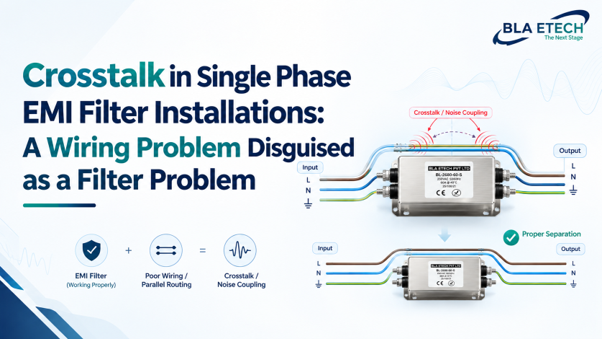
An engineer specs a single phase EMI filter with the right voltage rating, the right current rating, and solid attenuation numbers on the datasheet. It gets installed, the equipment goes to test, and the emissions test fails anyway. The instinct at this point is almost always the same: the filter must be wrong. Order a different one, try a higher-attenuation part, maybe escalate to the supplier. But in a meaningful number of cases, the filter was never the problem. The wiring around it was.
This is worth understanding properly because chasing a wiring problem with filter swaps wastes time, money, and design cycles without ever fixing the actual issue. Crosstalk in single phase EMI filter installations is one of the most common and most misdiagnosed causes of a failed EMI test, and it's worth knowing how to recognize before reaching for a different part.
Crosstalk, in an EMI filter installation, is noise coupling from one wire or trace to another that's routed nearby, most commonly from the unfiltered input side of the filter back onto the filtered output side. The filter itself might be doing exactly what it's rated to do, attenuating conducted noise as it passes through the component, but if the input and output wiring run close together, parallel, or share a connector or panel cutout, high-frequency noise can jump across that gap through capacitive or inductive coupling and bypass the filter entirely.
The result looks identical to a filter failure from the test bench. The emissions test shows noise it shouldn't. The natural conclusion is that the EMI filter isn't attenuating enough. But if the noise is coupling around the filter rather than through it, no amount of additional attenuation inside the filter will fix it, because the filter was never in that noise's actual path.
Part of the reason crosstalk gets blamed on the filter is that it's genuinely hard to see. A wiring layout can look clean on a schematic and still create a coupling path in the physical build, especially in compact enclosures where space constraints push input and output cabling closer together than a clean design would prefer. Another reason is that swapping the filter feels like the more actionable step. It's easier to order a different single phase EMI filter and retest than to redo a wiring harness or reroute a panel, so that's often what happens first, even when it doesn't address the root cause.
This is a genuine blind spot across the industry, not just for less experienced teams. Even seasoned engineers can spend a full test cycle troubleshooting a filter that was performing correctly the whole time.
A few patterns show up repeatedly in the field. Input and output leads run through the same cable bundle or wire loom instead of being physically separated. A filter is mounted with unfiltered and filtered leads passing close to each other inside the enclosure rather than being routed to opposite sides. Grounding is inconsistent, with the filter's ground connection sharing a path with noisy return currents elsewhere in the chassis. Any of these can create a coupling path that undermines an otherwise correctly specified single phase EMI filter.
Before replacing a filter that's failing a test, a few checks are worth doing first. Physically inspect the routing between the filter's input and output leads, if they're anywhere near each other, that's the first thing to fix, not the filter. Check whether the filter's ground connection is solid and isolated from noisy return paths rather than shared with them. If possible, temporarily reroute or separate the input and output wiring and retest before ordering a different part. If the emissions drop significantly just from separating the wiring, the original filter was fine, and the fix was never a component change.
This is also where the manufacturer you're working with matters more than most buyers expect. A single phase EMI filter manufacturer that only sells a part number and a datasheet leaves you to solve installation problems on your own, often after a failed test has already cost time. A manufacturer that understands installation behavior, not just the electrical spec, can flag a routing risk before it becomes a retest.
BLA Etech works through exactly this kind of installation guidance with customers, because a correctly rated filter installed with poor wiring practice will still fail, and that failure isn't fixed by a different part number. For general-purpose single-phase applications, a filter like BLA Etech's BL2010-01-F performs as specified when it's installed with proper separation between input and output wiring, but like any single phase EMI filter, its rated attenuation only holds if noise is actually forced through it rather than allowed to route around it.
Before assuming a single phase EMI filter has failed, rule out the wiring first. Check lead separation, check grounding, and retest with a corrected layout before ordering a replacement part. This single step saves more redesign cycles than almost any other troubleshooting habit in EMI compliance work. BLA Etech treats this as part of ordinary customer support because the goal isn't just shipping a filter that meets spec on paper; it's making sure that spec actually holds once the part is sitting in your enclosure.


